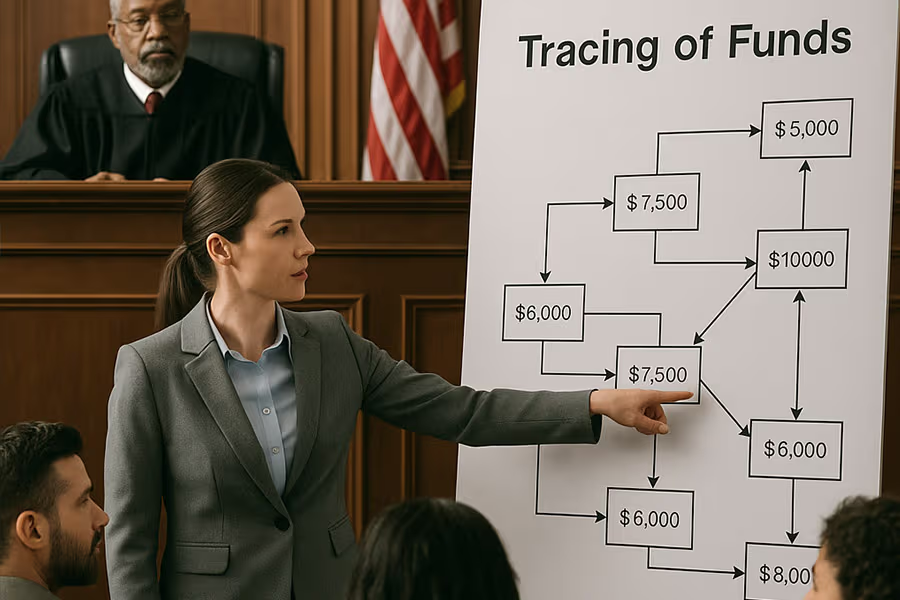
Whether your forensic accountant is retained to calculate economic damages, conduct a fraud investigation, or perform a business valuation, these four financial documents can almost always serve as the foundation to assess the financial issues in any forensic accounting case. In some cases, these four financial documents may be everything your forensic accountant needs to prepare a sound financial analysis and testify in deposition or trial.
The Four Essential Documents
With these four documents, your forensic accountant will have the ability to:
- Assess the financial history and analyze trends of the entity through their financial statements.
- Investigate specific transactions and how they were recorded in the general ledger.
- Understand how the entity reported its financials under penalty of perjury to the IRS.
- Analyze the distributions taken out and the contributions put in by the owners of the entity.
- Verify specific transactions in the bank records and verify the accuracy of the financial statements.
Document Categories
1. Financial Statements
Complete financial statements provide the foundation for understanding the entity's financial position and performance over time.
2. General Ledgers
Detailed general ledger records allow forensic accountants to trace individual transactions and identify irregularities.
3. Tax Returns
Tax returns show how the entity reported its financial information to the IRS under penalty of perjury.
4. Bank Statements
Bank statements provide independent verification of financial transactions and cash flows.
Case Applications
Since every case presents its own set of distinct issues, your expert may need to request additional financial and business records to conduct their analysis. While it's always best to retain your experts early, if you find yourself in a position where discovery is closing and you haven't spoken with your financial expert, requesting these four key financial documents may be just what your forensic accounting expert needs.
Obtaining (1) Financial Statements (2) General Ledgers, (3) Tax Returns, and (4) Bank Statements will most likely be crucial to your forensic accounting expert in the following types of cases: Economic Damages, Fraud Investigation, Business Valuation, Bankruptcy & Insolvency, Intellectual Property (IP) Litigation, Real Estate Litigation, Construction Litigation, Alter Ego, Fraudulent Transfers, Employment Litigation, Business Interruption, Personal Injury, Accounting Malpractice, and Partnership / Shareholder Disputes.